
The record, the same afternoon.
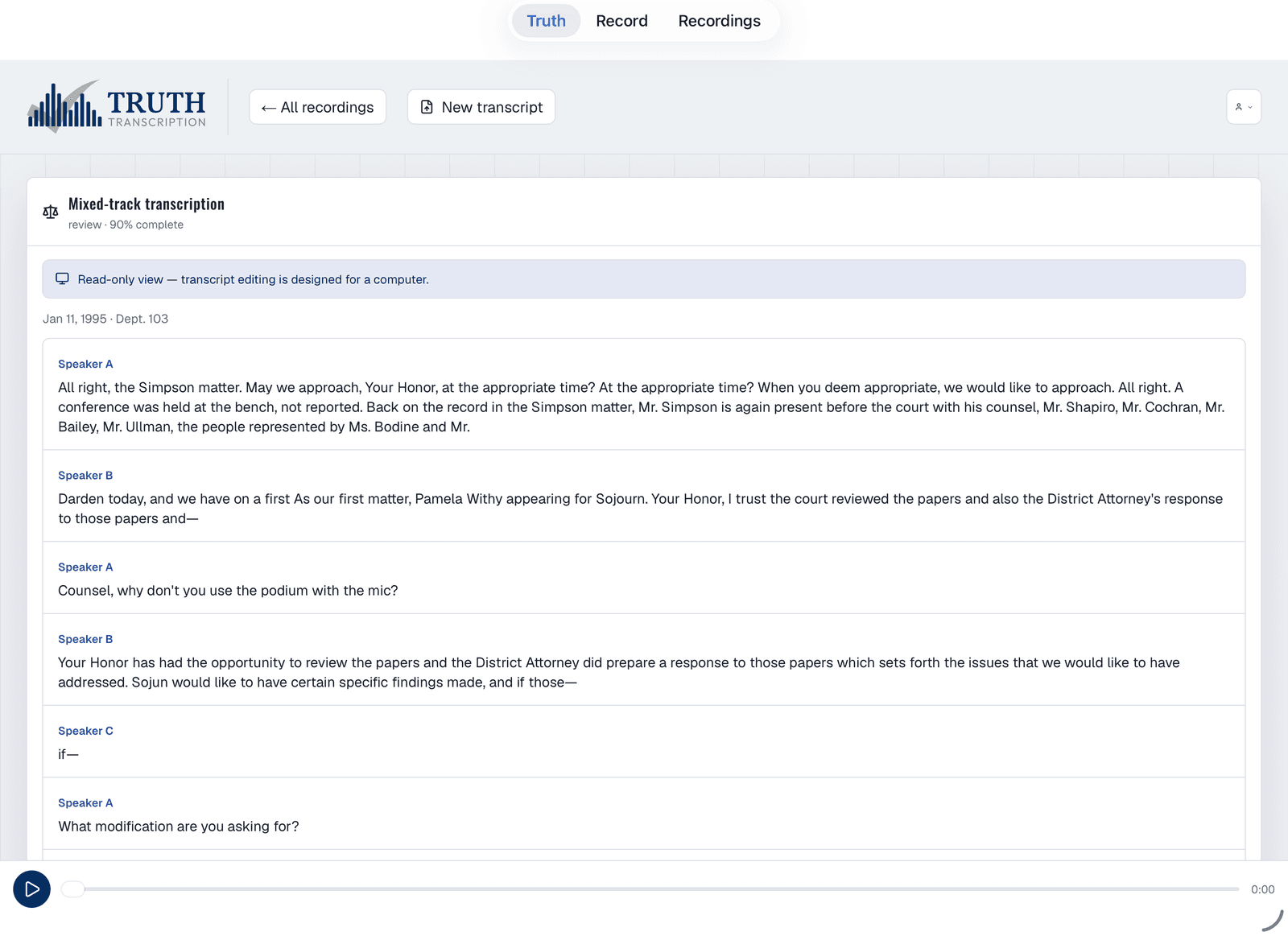
Truth Transcription records the proceeding, hands you a readable draft on the device before you leave the room, and finishes it in post-production with every speaker attributed by the microphone they spoke into.
No steno machine. No dictation software to install. One subscription, in the browser.
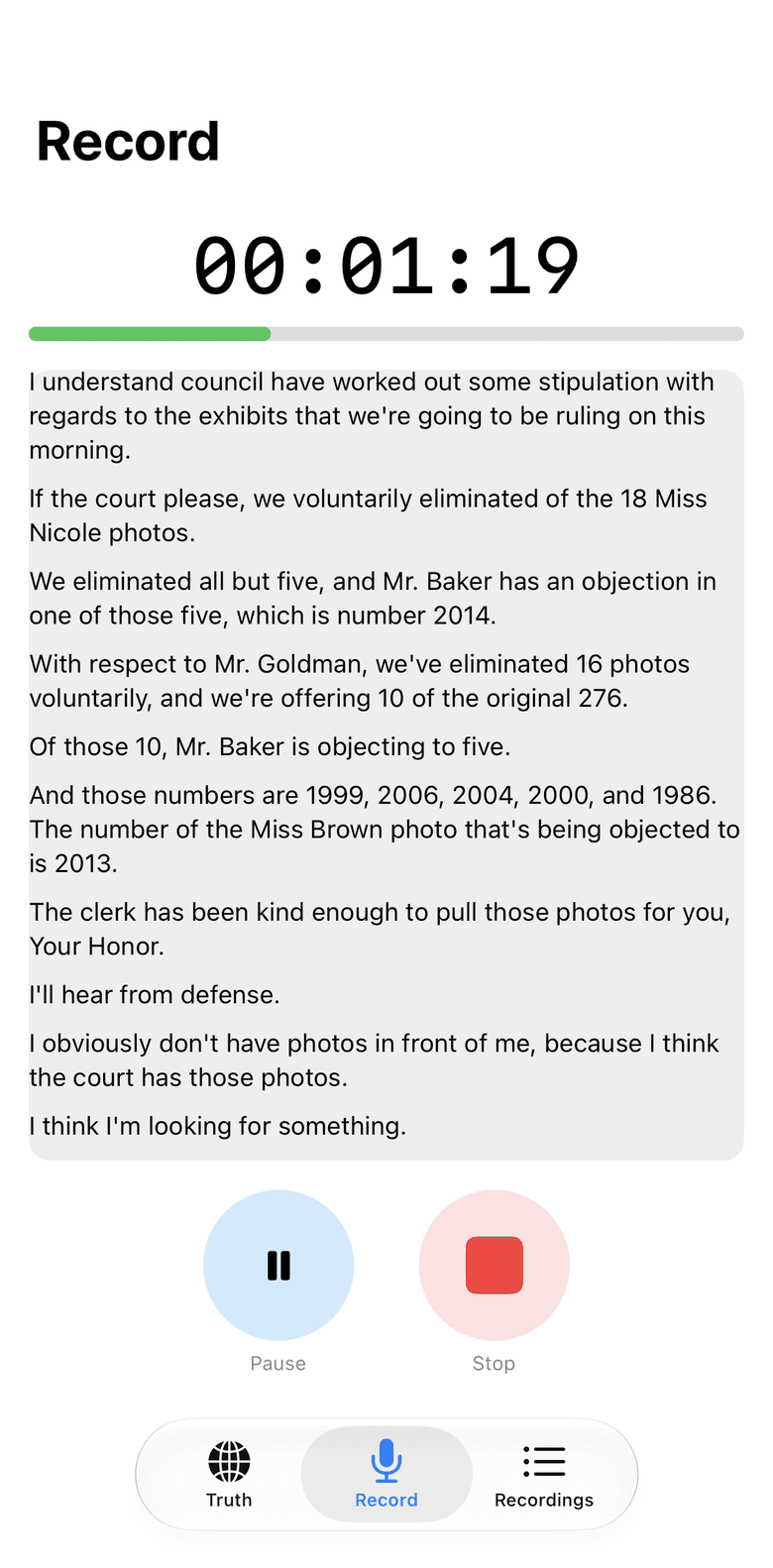
- counsel you may proceed thank you your honor
- mr delgado you testified earlier that you
- arrived at the warehouse at approximately
- nine fifteen is that correct yes that's right
- and the loading dock door was already open
- when you got there it was open yes about
- halfway objection your honor leading
- sustained rephrase counsel when you arrived
- what was the condition of the loading dock
- door it was open about halfway i could see
- the palettes inside and did you see anyone
- near the door i saw one person by the
- forklift i didn't recognize him
Two passes over one recording
Speed and accuracy pull in opposite directions. So we do not ask one pass to deliver both.
In the room
The app on your phone or tablet records and transcribes on the device itself, with no connection needed. By the time the hearing adjourns you can read back what was said, search it, and answer counsel's question about what the witness said an hour ago.
In post-production
When you are back online the recording uploads and the full pipeline runs: each microphone channel is transcribed on its own, timestamps are mapped back to the original audio, and every line is attributed to the person whose mic picked it up. You review, correct, and export in court format.
Speakers by microphone, not by guess
Generic transcription services listen to a mixed recording and guess who is talking from the sound of their voice. They split one person into three, or fold two people into one, and someone has to untangle it afterwards.
Courtrooms and deposition suites already have a microphone per participant. Truth Transcription keeps those channels separate all the way through, so attribution is a fact of the recording rather than an inference. You name the channels once. Every line lands on the right speaker.
What it replaces
The traditional setup is a stenotype writer, a computer-aided transcription suite, a dictation package, and years of training to make them work together.
- Equipment
- A stenotype writer, bought and maintained.
- The recorder you already have, or a phone.
- Software
- CAT software licenses, support plans, and dictation packages installed per seat.
- The browser. Nothing to install, nothing to renew.
- First draft
- Hours to days after the proceeding, unless a realtime stenographer is in the room.
- On the device, as the proceeding happens.
- Cost
- Thousands up front, then upgrades and renewals.
- A monthly subscription.
See it on one of your own recordings
Bring a multichannel WAV from a hearing or deposition. We will run it through and walk you through the result.